Reputation or Character
So offend sports and everyday life can bring the true character out in you. We are just wanting to encourage you to see which is more imporant this world. Is the most imporant to you being your reputation, or is your true character shining through today! Something to think about not only as netball player, but as a person!
Reputation is what you are supposed to be.
Character ist what you are.
Reputation is a photograph.
Character is your face.
Reputation is what you have when you come to a new place.
Character is what you have when you go away.
Reputation is learned in an hour.
Character does not come to light for years.
Reputation is made in a moment.
Character is built in a lifetime.
Reputation grows like a mushroom.
Character grows like an oak.
Reputation is made from a single newspaper report.
Character is built life of toil.
Reputation makes you rich or poor.
Character makes you happy or miserable.
Reputation is what men say about you on your tombstone.
Character ist what the angels say about you around the throne of God.
Friday, October 13, 2006

Thursday, October 12, 2006
Netball rebounding drill
Netball rebounding drill
Rebounding
In this netball rebounding drill, you have players pick partners 1 shooter, 1 rebounder. Shooter has 10 shots from under the post. Rebounder defends each shot and collects the rebound. Having changed round, the exercise is then repeated from a little further out.
Key Coaching points:
* Shooter must set up and get balanced before taking the shot.
* Shooter must follow every shot and attempt the rebound against the defence.
Netball rebounding drill
Rebounding
In this netball rebounding drill, you have players pick partners 1 shooter, 1 rebounder. Shooter has 10 shots from under the post. Rebounder defends each shot and collects the rebound. Having changed round, the exercise is then repeated from a little further out.
Key Coaching points:
* Shooter must set up and get balanced before taking the shot.
* Shooter must follow every shot and attempt the rebound against the defence.
Netball rebounding drill
Netball warm up game, warm up drill
Netball warm up game, warm up drill
some call duck and goose, fox and geese, whatever you want to call it.
Description of the netball warm up drill or warm up game:
This netball warm up drill and netball warm up game you need 3 players. All of the first three players, players 1, 2 and 3 all hold the hips of the player in front of them. The defender (opposite player) tries to tag the back of one of the other nominated players (in this case player 3).
some call duck and goose, fox and geese, whatever you want to call it.
Description of the netball warm up drill or warm up game:
This netball warm up drill and netball warm up game you need 3 players. All of the first three players, players 1, 2 and 3 all hold the hips of the player in front of them. The defender (opposite player) tries to tag the back of one of the other nominated players (in this case player 3).
Wednesday, October 11, 2006
Turning and changing direction
Turning and changing direction
footwork netball drill
The player run into a space. Then on the whistle jump into the air, landing right or left. Turn on first landing foot, point other foot into new space and run into it.
Same can be done with a ball. On the whistle, throw ball in the air, jump, catch, land and pivot.
Coaching key points: Could spread cones or anything ( or old carpet squares ) on ground for the players to run towards and land on.
footwork netball drill
The player run into a space. Then on the whistle jump into the air, landing right or left. Turn on first landing foot, point other foot into new space and run into it.
Same can be done with a ball. On the whistle, throw ball in the air, jump, catch, land and pivot.
Coaching key points: Could spread cones or anything ( or old carpet squares ) on ground for the players to run towards and land on.
netball footwork drill
Netball Footwork Drill
Description: 4 players or more. 1 ball.
Blue 1 drives forward to receive the ball from White 1.
Blue 1 lands, turns and feeds to Blue 2, before returning to the back of the blue line.
Blue 2 feeds to White 1 driving on to the ball.
Coaching key notes:
* Have your players or remind them not to rush through this drill.
* Remind them to jump to receive the ball.
* Focus on landing with there knees bent and balanced!
Netball Footwork Drill
Description: 4 players or more. 1 ball.
Blue 1 drives forward to receive the ball from White 1.
Blue 1 lands, turns and feeds to Blue 2, before returning to the back of the blue line.
Blue 2 feeds to White 1 driving on to the ball.
Coaching key notes:
* Have your players or remind them not to rush through this drill.
* Remind them to jump to receive the ball.
* Focus on landing with there knees bent and balanced!
Netball Footwork Drill
Netball court diagram
To go with the blank court diagram, here are a few quick bits.
A Netball court is divided into 3 thirds, with a Goal third at each end & the middle third being called the Centre Third.
The long lines down the side of the court are called the Side Lines, the end lines called the Base Lines & the lines dividing the thirds are called Transverse lines.
The semi-circles at each end are called Goal Circles and is the only area on the court from where a gaol can be scored. There is a post with a ring attached in the middle of the base line at each end and a goal is scored when the ball is shot from the Goal Circle & it passes through the Goal Ring.
In the centre of the court is a circle called appropriately enough, the Centre Circle. From inside the Centre Circle a player starts the game with the ball and passes to someone on their team. this is called the Centre Pass. After a goal is scored, the ball comes back to the Centre Circle for another Centre Pass, with each team taking alternate Centre Passes.
A Netball court is divided into 3 thirds, with a Goal third at each end & the middle third being called the Centre Third.
The long lines down the side of the court are called the Side Lines, the end lines called the Base Lines & the lines dividing the thirds are called Transverse lines.
The semi-circles at each end are called Goal Circles and is the only area on the court from where a gaol can be scored. There is a post with a ring attached in the middle of the base line at each end and a goal is scored when the ball is shot from the Goal Circle & it passes through the Goal Ring.
In the centre of the court is a circle called appropriately enough, the Centre Circle. From inside the Centre Circle a player starts the game with the ball and passes to someone on their team. this is called the Centre Pass. After a goal is scored, the ball comes back to the Centre Circle for another Centre Pass, with each team taking alternate Centre Passes.
Tuesday, October 03, 2006
netball, netball handling drills, and ball control
Here are some basic netball drils. Look at how much fun these girls are having with this great sport of netball. Here are some basic netball handling drills. These drills help you get a good feel for the ball, ball control, and conditioning!
Check out this AWESOME netball video!
Check out this AWESOME netball video!
Monday, September 11, 2006
netball the game of inches
Netball is a fast pace game where one inch or cm could make the difference in the outcome of the game. An cm or inch here or there, an shot an cm or inch off is missed, a pass an inch off is stolen. This is why the smallest things such as a cm or inch could be the difference of a win or lose for your team.
Your team really needs to focus on doing all the little things taking it cm or inch at a time to success. You've got to make sure you're doing all the little things that can add up and give you a big advantage and help you succeed.
I would like to make this illustration to help paint the picture better for. The carpenter is making a table. Well, if he starts by making just one of the legs of this table a cm or inch shorter or longer. Then that table wabble for the rest of the time! No really likes a wabbling table to eat on! But, because the carpenter was just one cm or inch off from the start now the complete table is defected!
As an offensive player, having the chance to gain a cm or inch with quick moves and quick decisions is a great way to gain yourself a clear advantage over the defense.
Your team really needs to focus on doing all the little things taking it cm or inch at a time to success. You've got to make sure you're doing all the little things that can add up and give you a big advantage and help you succeed.
I would like to make this illustration to help paint the picture better for. The carpenter is making a table. Well, if he starts by making just one of the legs of this table a cm or inch shorter or longer. Then that table wabble for the rest of the time! No really likes a wabbling table to eat on! But, because the carpenter was just one cm or inch off from the start now the complete table is defected!
As an offensive player, having the chance to gain a cm or inch with quick moves and quick decisions is a great way to gain yourself a clear advantage over the defense.
Tuesday, August 22, 2006
netball coaching tips, coaching ideas to keeping it fresh
Netball coaching tips to keep things fresh, fun, and fantastic times. These are some things that came up with coaching younger netball teams. These are young netball players that sometimes have a hard time focusing and working hard for long period of times. So here are some coaching tips of getting the most of your players.
1. Make training short and sharp - 1 hour max. but they work hard for that
time...and I mean hard!
2. Vary each session so that sometimes ball work is at the end and tactics
at the start etc.
3. Sometimes just organise a practice match or round robin.
4. Sometimes play a game but I find setting very specific goals for 5 min
segments works well. Set a goal, play for 5 mins - 1min only break to assess
and set the next goal - play another 5mins etc. This can keep players really
focused especially if you set a goal that can be kept score.
5. Try to make all drills into a game of some sort so players don't know
they are learning. Some coaches teach totally through games and structure it
so players are discovering things themselves. This can work very well.
Remember if something has worked very well one week it's unlikely to work
well the next.....keep coming up with different ideas. Coaching certainly
is challenging....but rewarding too.
1. Make training short and sharp - 1 hour max. but they work hard for that
time...and I mean hard!
2. Vary each session so that sometimes ball work is at the end and tactics
at the start etc.
3. Sometimes just organise a practice match or round robin.
4. Sometimes play a game but I find setting very specific goals for 5 min
segments works well. Set a goal, play for 5 mins - 1min only break to assess
and set the next goal - play another 5mins etc. This can keep players really
focused especially if you set a goal that can be kept score.
5. Try to make all drills into a game of some sort so players don't know
they are learning. Some coaches teach totally through games and structure it
so players are discovering things themselves. This can work very well.
Remember if something has worked very well one week it's unlikely to work
well the next.....keep coming up with different ideas. Coaching certainly
is challenging....but rewarding too.
Monday, August 21, 2006
netball defensive drill, netball zone, netball court
Zone Out
Defensive Drill
Resources: 2 thirds of a netball court
Drill description:
Split your players into groups of two. One to attack – one to defend.
Defenders will line up along the middle transverse line between the 2 thirds.
Attackers will line up along the base line, matched up as a pair with 1 defender.
Attackers will run at defenders 2 at a time, from varied positions along the base line. It is up to the coach to select and call on 2 attackers.
The other players will wait to the side of the court until they are called upon.
The Defenders are to Zone the Attackers from getting into the area behind them.
Repeat the steps until all persons have had a turn, and change roles.
Coaching Points:
Ensure contact is monitored from both Attackers and Defenders.
If there are more courts, more players can go at once.
Be careful of too many people working this drill in a small place.
Variations:
Players can all be Attackers and one person is the Defender. After zoning several people, they join the end of the line of Attackers and someone else becomes the Defender. So on until everyone has had a substantial try at Zoning, perhaps giving the Defenders longer.
This can be utilised around the goal ring between Goal Attacking players and Goal Defending players.
As opposed to a one-on-one scenario, players can adopt a complete zone along the line and take on the Attacking player whom ever is closer at the time.
Progression:
This drill should help players develop Zoning skills. The focus of having 2 persons moving in the same area helps give more of a game feel. By this it’s more realistic that only having one on one as 2 defenders or more may be zoning in an actual game.
The idea is to get the basic skill perfected and then move on to the full complete zone, where a player will zone another and then if need be stay in their area and zone a different player who may come their way.
Defensive Drill
Resources: 2 thirds of a netball court
Drill description:
Split your players into groups of two. One to attack – one to defend.
Defenders will line up along the middle transverse line between the 2 thirds.
Attackers will line up along the base line, matched up as a pair with 1 defender.
Attackers will run at defenders 2 at a time, from varied positions along the base line. It is up to the coach to select and call on 2 attackers.
The other players will wait to the side of the court until they are called upon.
The Defenders are to Zone the Attackers from getting into the area behind them.
Repeat the steps until all persons have had a turn, and change roles.
Coaching Points:
Ensure contact is monitored from both Attackers and Defenders.
If there are more courts, more players can go at once.
Be careful of too many people working this drill in a small place.
Variations:
Players can all be Attackers and one person is the Defender. After zoning several people, they join the end of the line of Attackers and someone else becomes the Defender. So on until everyone has had a substantial try at Zoning, perhaps giving the Defenders longer.
This can be utilised around the goal ring between Goal Attacking players and Goal Defending players.
As opposed to a one-on-one scenario, players can adopt a complete zone along the line and take on the Attacking player whom ever is closer at the time.
Progression:
This drill should help players develop Zoning skills. The focus of having 2 persons moving in the same area helps give more of a game feel. By this it’s more realistic that only having one on one as 2 defenders or more may be zoning in an actual game.
The idea is to get the basic skill perfected and then move on to the full complete zone, where a player will zone another and then if need be stay in their area and zone a different player who may come their way.
Sunday, June 11, 2006
The attacking circle - tactics for shooters
The attacking circle - tactics for shooters
a sample session
Aim
To create smooth passages of play in and around the goal circle
The warm up
Always be thinking about the movements the players use in a game and design a warm up to assist them to concentrate on the job ahead. For example, jogging up and down the court is certainly increasing their blood flow to assist safe stretching. However, mentally, the activity does nothing at all. Instead, jogging around and over the court with special attention to the player’s particular playing area assists their concentration and preparation for the game.
Design a programme of activities which include:
* jogging with plenty of changes of direction
* jumping, turning and jogging around the goal circles
* jog backward forwards and sideways working in the goal
circle area with focus on the goal post.
* stretch with plenty of arm mobility exercises
* short sprint speed work including over one third, over two thirds for GA’s and plenty of 6 step pace work, e.g. goal line to top of the circle, across the circle etc.
The work out - a sequence of development
Movement skill
Place marker cones in the goal circle about 1 metre apart
Facing down court and using a running step, the shooter makes figures of 8, working around the cones.
Add the other shooter, emphasising the need to keep a balanced circle - exercise in spatial awareness and positioning.
Add a pass from a stationary feeder
Take the cones away try to keep the figure of 8 pattern going as much as possible.
Use chest and bounce passes, varying the distance, height and strength.
Stress the need for forward or diagonal backward movement to take a pass.
Add one player as a defender
The ball starts in the circle, passes out to the moving feeder, who passes to the free player, who shoots for goal with normal defending and rebounding taking place.
Stress the need for eye or ball faking by the feeder before the ball is passed.
Add another feeder (WA,C)
The ball travels from the centre with the pass going to the WA. Both shooters are in the circle moving in a figure of 8 pattern with one defender marking the players.
The ball is passed in and out of the circle three times before a shot is attempted.
Stress the need for cooperative play between the players with good body language and eye contact.
The GA stands out of the circle and could receive the centre pass
As a variation require the ball to be passed to the GA before it enters the shooting circle.
Again nominate the number of times the ball must be passed between the players before a shot is attempted.
Add defenders and build up into a centre pass strategy with options
of pass, in and around the circle.
a sample session
Aim
To create smooth passages of play in and around the goal circle
The warm up
Always be thinking about the movements the players use in a game and design a warm up to assist them to concentrate on the job ahead. For example, jogging up and down the court is certainly increasing their blood flow to assist safe stretching. However, mentally, the activity does nothing at all. Instead, jogging around and over the court with special attention to the player’s particular playing area assists their concentration and preparation for the game.
Design a programme of activities which include:
* jogging with plenty of changes of direction
* jumping, turning and jogging around the goal circles
* jog backward forwards and sideways working in the goal
circle area with focus on the goal post.
* stretch with plenty of arm mobility exercises
* short sprint speed work including over one third, over two thirds for GA’s and plenty of 6 step pace work, e.g. goal line to top of the circle, across the circle etc.
The work out - a sequence of development
Movement skill
Place marker cones in the goal circle about 1 metre apart
Facing down court and using a running step, the shooter makes figures of 8, working around the cones.
Add the other shooter, emphasising the need to keep a balanced circle - exercise in spatial awareness and positioning.
Add a pass from a stationary feeder
Take the cones away try to keep the figure of 8 pattern going as much as possible.
Use chest and bounce passes, varying the distance, height and strength.
Stress the need for forward or diagonal backward movement to take a pass.
Add one player as a defender
The ball starts in the circle, passes out to the moving feeder, who passes to the free player, who shoots for goal with normal defending and rebounding taking place.
Stress the need for eye or ball faking by the feeder before the ball is passed.
Add another feeder (WA,C)
The ball travels from the centre with the pass going to the WA. Both shooters are in the circle moving in a figure of 8 pattern with one defender marking the players.
The ball is passed in and out of the circle three times before a shot is attempted.
Stress the need for cooperative play between the players with good body language and eye contact.
The GA stands out of the circle and could receive the centre pass
As a variation require the ball to be passed to the GA before it enters the shooting circle.
Again nominate the number of times the ball must be passed between the players before a shot is attempted.
Add defenders and build up into a centre pass strategy with options
of pass, in and around the circle.
Monday, April 03, 2006
worker/thrower drill, netball worker/thrower drill
Worker
Thrower
Worker runs to space 1
Worker receives a pass from the Thrower and passes back.
Worker runs to space 2 and repeats until back to starting spot
Worker becomes the Thrower and the next person in the circle becomes the Worker.
*Thrower is to try and pass the ball into the space the worker is running onto.
*Worker is to try and take the pass, not step and give a good pass back to the Thrower.
Thrower
Worker runs to space 1
Worker receives a pass from the Thrower and passes back.
Worker runs to space 2 and repeats until back to starting spot
Worker becomes the Thrower and the next person in the circle becomes the Worker.
*Thrower is to try and pass the ball into the space the worker is running onto.
*Worker is to try and take the pass, not step and give a good pass back to the Thrower.
zone break drill netball
zone break drill
Imagine the star is the defender and the bolt is the attacker.
The object is to have the pair outside the circle STAY outside the circle.
The goalie can then stand at the top of the circle, leaving the area closest to the goal ring empty
Using her/his body, the goalie can set themselves up to receive a chest pass as the defender will be standing behind them zoning OR
Set up for the lob.
For the lob to work the goalie must have herself between the defender and the goal post.
She must hold her ground until the last minute and the pass must be spot on over her head, into the empty space, setting her up for a closer shot
As soon as the lob has been released, the other attacking goalie must run into the circle ready to help.
This all happens very quickly and despite some defenders being switched on, you’d be surprised the number of times I’ve done this as a goalie for the duration of a whole game!
Picture 1 refers to steps 2 – 3.
Picture 2 refers to how the goal circle should be set up and where the pass should be directed – steps 5 – 8.
If we get to step 4 and the only option is to receive a chest pass and still be in the outer of the circle, you need to position your WA and C at the edges of the circle, like the 2 and 5 on a clock. (picture 3). If the person on the circle holds their ground on the edge of the ring, the defenders can only get the ball by committing an offence. Hopefully the umpires are good enough to pick any infringements like contact, off side or obstruction.
Imagine the star is the defender and the bolt is the attacker.
The object is to have the pair outside the circle STAY outside the circle.
The goalie can then stand at the top of the circle, leaving the area closest to the goal ring empty
Using her/his body, the goalie can set themselves up to receive a chest pass as the defender will be standing behind them zoning OR
Set up for the lob.
For the lob to work the goalie must have herself between the defender and the goal post.
She must hold her ground until the last minute and the pass must be spot on over her head, into the empty space, setting her up for a closer shot
As soon as the lob has been released, the other attacking goalie must run into the circle ready to help.
This all happens very quickly and despite some defenders being switched on, you’d be surprised the number of times I’ve done this as a goalie for the duration of a whole game!
Picture 1 refers to steps 2 – 3.
Picture 2 refers to how the goal circle should be set up and where the pass should be directed – steps 5 – 8.
If we get to step 4 and the only option is to receive a chest pass and still be in the outer of the circle, you need to position your WA and C at the edges of the circle, like the 2 and 5 on a clock. (picture 3). If the person on the circle holds their ground on the edge of the ring, the defenders can only get the ball by committing an offence. Hopefully the umpires are good enough to pick any infringements like contact, off side or obstruction.
Sunday, March 26, 2006
netball New Zealand, International Netball commonwealth crown!
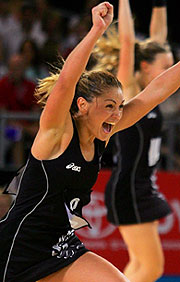
Commonwealth champions!!
26 March 2006
Congratulations to New Zealand, who in a tough and skillfull match beat Australia 60 goals to 55, taking the Commonwealth Crown
In the Earlier nailbiting BRONZE medal match England beat Jamaica, scoring in the last seconds. Final score England 53 v Jamaica 52.
NEW ZEALAND - GOLD
AUSTRALIA - SILVER
ENGLAND - BRONZE
Saturday, March 25, 2006
New Zealand netball, international netball, commonweatlh netball
The New Zealand Silver Ferns secured their spot in the Gold Medal Match of the 2006 Commonwealth Games after a comfortable win over Jamaica in their semi final tonight at the Multi Purpose Venue in Melbourne.
Quarter by Quarter scores for the match:
1st Quarter NZ 18 - Jam 7
2nd Quarter NZ 32 - Jam 17
3rd Quarter NZ 48 - Jam 28
4th Quarter NZ 61 - Jam 41
New Zealand will meet the winner of the Australia v England Semi Final in the Gold Medal Match at 4pm tomorrow afternoon, Sunday 26 March.
Jamaica will play for a bronze medal against the loser of the Australia v England semi final at 2pm Sunday 26 March.
Quarter by Quarter scores for the match:
1st Quarter NZ 18 - Jam 7
2nd Quarter NZ 32 - Jam 17
3rd Quarter NZ 48 - Jam 28
4th Quarter NZ 61 - Jam 41
New Zealand will meet the winner of the Australia v England Semi Final in the Gold Medal Match at 4pm tomorrow afternoon, Sunday 26 March.
Jamaica will play for a bronze medal against the loser of the Australia v England semi final at 2pm Sunday 26 March.
netball international, international netball
Day 8 of Netball, Friday March 24
St Vincent & The Grenadines (52) def. Singapore (46)
South Africa (46) def. Wales (43)
Fiji (69) def. Barbados (45)
Samoa (53) def. Malawi (50)
St Vincent & The Grenadines (52) def. Singapore (46)
South Africa (46) def. Wales (43)
Fiji (69) def. Barbados (45)
Samoa (53) def. Malawi (50)
Netball showdowns
It's down to the Semi Finals of the Games Netball competition, with New Zealand playing Jamaica at 6.30pm and Australia taking on England at 8.30pm for a place in the gold medal match on Day 11 (26 March).
In the first Semi Final at the Multi Purpose Venue, World Champions New Zealand will meet a dangerous Jamaican outfit.
New Zealand finished on top of group one, but will need to be at the top of their game against their Jamaican opponents, who finished second in group two behind Australia on percentage.
Jamaica staged a courageous 10-goal fight back against Australia to draw 54-54 in the Preliminary Rounds, nearly sneaking top spot in Group 2 from the pre-Games favourites.
New Zealand is yet to be pushed in any of its matches and have been impressive in the preliminary rounds.
Goal shooters Irene Van Dyk and Jamaican captain Elaine Davis hold the key for their respective teams, with the shooting accuracy and towering strength of both crucial to their teams’ success.
The match-up in the centre between New Zealand's Temepara George and Jamaica’s Nadine Bryan also promises to be a thrilling dual between two exciting and athletic players.
Both are the driving forces in their line-ups and the outcome of this clash could be a deciding factor in the outcome of the match.
New Zealand clearly deserves to start as the favourite, but Jamaica is capable of causing a major upset, particularly if they can keep their unforced errors to a minimum and remain disciplined for the hour-long encounter.
In the second Semi Final, Manchester 2002 Games gold medallists Australia will take on an England side who have been slowly gathering momentum with each match.
England's defenders Geva Mentor and Sonia Mkoloma will provide a difficult challenge for the Australian shooters, with the battle between Australia’s Captain Sharelle McMahon and Mkoloma likely to be one of the games pivotal contests.
Australia has suffered some lapses in concentration at times, but has always managed to put some brilliant passages of play together during their Preliminary Rounds to get them out of trouble. The Australian team's shooting percentages are also very high with debutante Susan Pratley returning an 89 per cent strike rate.
The Australians will need to apply strong full-court defensive pressure to subdue the speed of England’s mid-court, with Captain Olivia Murphy playing a crucial role in the centre.
Australia's big match experience and superior physical presence should prove too strong for England.
In the first Semi Final at the Multi Purpose Venue, World Champions New Zealand will meet a dangerous Jamaican outfit.
New Zealand finished on top of group one, but will need to be at the top of their game against their Jamaican opponents, who finished second in group two behind Australia on percentage.
Jamaica staged a courageous 10-goal fight back against Australia to draw 54-54 in the Preliminary Rounds, nearly sneaking top spot in Group 2 from the pre-Games favourites.
New Zealand is yet to be pushed in any of its matches and have been impressive in the preliminary rounds.
Goal shooters Irene Van Dyk and Jamaican captain Elaine Davis hold the key for their respective teams, with the shooting accuracy and towering strength of both crucial to their teams’ success.
The match-up in the centre between New Zealand's Temepara George and Jamaica’s Nadine Bryan also promises to be a thrilling dual between two exciting and athletic players.
Both are the driving forces in their line-ups and the outcome of this clash could be a deciding factor in the outcome of the match.
New Zealand clearly deserves to start as the favourite, but Jamaica is capable of causing a major upset, particularly if they can keep their unforced errors to a minimum and remain disciplined for the hour-long encounter.
In the second Semi Final, Manchester 2002 Games gold medallists Australia will take on an England side who have been slowly gathering momentum with each match.
England's defenders Geva Mentor and Sonia Mkoloma will provide a difficult challenge for the Australian shooters, with the battle between Australia’s Captain Sharelle McMahon and Mkoloma likely to be one of the games pivotal contests.
Australia has suffered some lapses in concentration at times, but has always managed to put some brilliant passages of play together during their Preliminary Rounds to get them out of trouble. The Australian team's shooting percentages are also very high with debutante Susan Pratley returning an 89 per cent strike rate.
The Australians will need to apply strong full-court defensive pressure to subdue the speed of England’s mid-court, with Captain Olivia Murphy playing a crucial role in the centre.
Australia's big match experience and superior physical presence should prove too strong for England.
Friday, March 24, 2006
Day 7 of commonwealth netball internaional games
Day 7 of of commonwealth netball internaional games Netball, Thursday March 23
Wales (55) def. Barbados (34)
Fiji (58) def. St Vincent and The Grenadines (44)
Australia (107) def. Singapore (19)
New Zealand (67) def. Malawi (39)
England (67) def. South Africa (35)
Jamaica (60) def. Samoa (47)
Wales (55) def. Barbados (34)
Fiji (58) def. St Vincent and The Grenadines (44)
Australia (107) def. Singapore (19)
New Zealand (67) def. Malawi (39)
England (67) def. South Africa (35)
Jamaica (60) def. Samoa (47)
Wednesday, March 22, 2006
netball australia vs. jamaica!
One of the hottest games of the Netball competition has been played out between Jamaica and Australia.
After an even first half, Australia had a dominant third quarter, extending their lead to 43-34 going into the fourth period.
The Australians continued to dominate in the early stages of the quarter, until Jamaica rallied to stage a brilliant comeback through the accuracy of shooters Elaine Davis and Simone Forbes.
Australia then lost control and the Jamaicans snatched the draw in the final seconds, 54-54 - the third time the two teams have drawn.
Although disappointed with the final score, Australia’s Sharelle McMahon congratulated her opponents on their performance.
"Full credit to Jamaica and also to our girls, we had some beautiful passages of play," she said. "We've got some things to work on but we did some great things too.”
The other day seven games have also been a battle to the end.
Samoa narrowly defeated Barbados, in a match that see-sawed until Samoa picked up its accuracy and defensive pressure.
Samoan goal shooter, Monika Fuimaono struggled to find her range, leaving goal attack Malu Faasavalu to take on most of the shots, keeping Samoa in front at half time, 25-16.
In the third quarter Barbados showed sparks of brilliance, but Samoa kept the upper hand.
In a bruising final quarter Barbados threw everything into their game, as the ever-steady shooting of Lydia Bishop and the inspiring brilliance of dynamic goal attack Latonia Blackman set the crowd alight. Samoa relied heavily on experience and composure to hold off the challengers, who came within three goals of toppling them.
South Africa won a thrilling match against Fiji, despite the lead changing hands at the change of ends.
In the second quarter, goal attack for South Africa, Lizanne Helmand, was in great form with sensational accuracy. The third quarter was also close, with South Africa limiting Fiji’s supply of the ball and both sides shooting 12 goals.
The Fijians came within three goals of the lead in the final quarter, but a composed South Africa saw out the game to finish 56-51.
"I'd just like to thank all the girls in the team for their effort in the last quarter. We fought hard and I love you all," said Fiji’s Matila Waganidrola. "Thanks to the crowd and all the supporters and especially to the Australian Fijians."
After an even first half, Australia had a dominant third quarter, extending their lead to 43-34 going into the fourth period.
The Australians continued to dominate in the early stages of the quarter, until Jamaica rallied to stage a brilliant comeback through the accuracy of shooters Elaine Davis and Simone Forbes.
Australia then lost control and the Jamaicans snatched the draw in the final seconds, 54-54 - the third time the two teams have drawn.
Although disappointed with the final score, Australia’s Sharelle McMahon congratulated her opponents on their performance.
"Full credit to Jamaica and also to our girls, we had some beautiful passages of play," she said. "We've got some things to work on but we did some great things too.”
The other day seven games have also been a battle to the end.
Samoa narrowly defeated Barbados, in a match that see-sawed until Samoa picked up its accuracy and defensive pressure.
Samoan goal shooter, Monika Fuimaono struggled to find her range, leaving goal attack Malu Faasavalu to take on most of the shots, keeping Samoa in front at half time, 25-16.
In the third quarter Barbados showed sparks of brilliance, but Samoa kept the upper hand.
In a bruising final quarter Barbados threw everything into their game, as the ever-steady shooting of Lydia Bishop and the inspiring brilliance of dynamic goal attack Latonia Blackman set the crowd alight. Samoa relied heavily on experience and composure to hold off the challengers, who came within three goals of toppling them.
South Africa won a thrilling match against Fiji, despite the lead changing hands at the change of ends.
In the second quarter, goal attack for South Africa, Lizanne Helmand, was in great form with sensational accuracy. The third quarter was also close, with South Africa limiting Fiji’s supply of the ball and both sides shooting 12 goals.
The Fijians came within three goals of the lead in the final quarter, but a composed South Africa saw out the game to finish 56-51.
"I'd just like to thank all the girls in the team for their effort in the last quarter. We fought hard and I love you all," said Fiji’s Matila Waganidrola. "Thanks to the crowd and all the supporters and especially to the Australian Fijians."
Tuesday, March 21, 2006
netball australia yet to come!
Day 6 of Netball, Wednesday March 22
Samoa (45) def. Barbados (41)
South Africa vs. Fiji
Australia vs. Jamaica
New Zealand vs. England
Day 7 of Netball, Thursday March 23
Barbados vs. Wales
Fiji vs. St Vincent and The Grenadines
Singapore vs. Australia
Malawi vs. New Zealand
South Africa vs. England
Samoa vs. Jamaica
Samoa (45) def. Barbados (41)
South Africa vs. Fiji
Australia vs. Jamaica
New Zealand vs. England
Day 7 of Netball, Thursday March 23
Barbados vs. Wales
Fiji vs. St Vincent and The Grenadines
Singapore vs. Australia
Malawi vs. New Zealand
South Africa vs. England
Samoa vs. Jamaica
Subscribe to:
Posts (Atom)